- Ecommerce SEO gets your store ranked on Google. Answer engine optimization (AEO) gets your answers extracted. Generative engine optimization (GEO) gets your brand named in AI-generated answers.
- They are one stack, not three strategies. Technical health and strong product and category pages come first, because AI systems retrieve from the same web that search engines crawl.
- Most AI crawlers don’t render JavaScript. If your product details only load client-side, ChatGPT and Perplexity may see an empty page.
- ChatGPT’s browsing draws on Bing’s index, so Bing visibility matters as much as Google for AI search.
- AI visibility is earned off-site too. Reviews, marketplace listings, YouTube, Reddit and consistent brand descriptions shape whether AI recommends you.
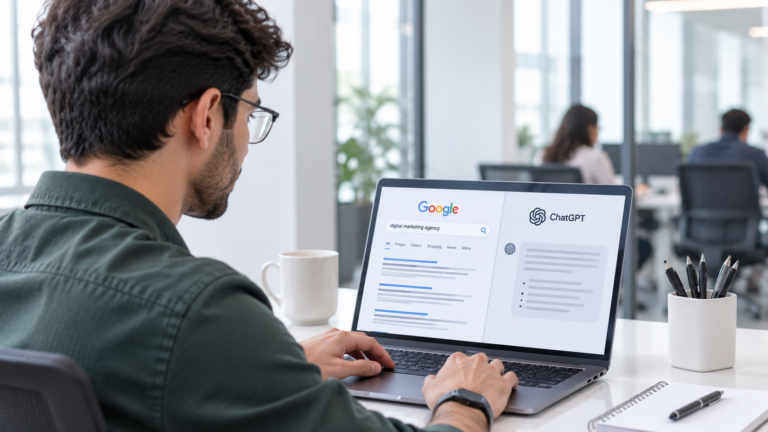
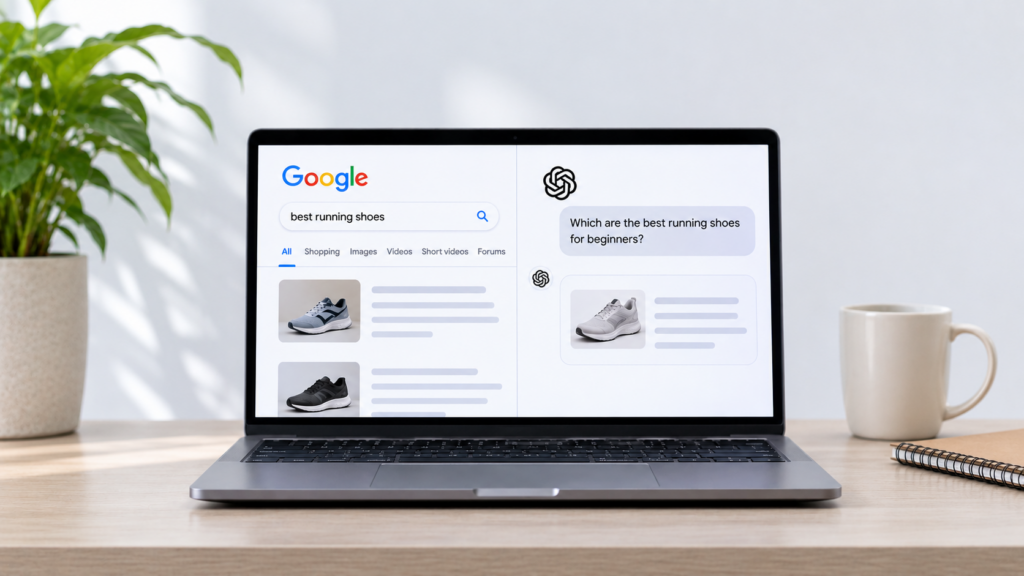
Shoppers no longer start every product search on Google. Many now ask ChatGPT, Gemini or Perplexity which brand to buy, and read the answer instead of a list of links. Ecommerce SEO still decides whether your store gets found, but it now has two partners: answer engine optimization and generative engine optimization.
This guide shows founders and marketing leaders how the three work together, what to fix first, how to structure product and category pages for AI, how to earn brand mentions in AI answers, and how to measure the impact on revenue.
SEO, AEO and GEO: What Each One Means for E-commerce
SEO, AEO and GEO are three layers of the same goal: making your store the answer when a shopper searches, asks or compares. Each targets a different way people now discover products.
Three definitions in plain language
Ecommerce SEO (search engine optimization) is the work of making your store’s category, product and content pages rank in search results on Google and Bing.
Answer engine optimization (AEO) is structuring content so search features and AI assistants can pull a direct answer from your page, such as a featured snippet, a People Also Ask result or a voice answer.
Generative engine optimization (GEO) is improving the chances that AI systems like ChatGPT, Gemini, Perplexity and Google AI Overviews mention, recommend or cite your brand in the answers they generate.
| SEO | AEO | GEO | |
|---|---|---|---|
| Goal | Rank pages | Get answers extracted | Get the brand named and cited |
| Where it shows | Search results | Snippets, People Also Ask, voice | ChatGPT, Gemini, Perplexity, AI Overviews |
| Main lever | Technical health, relevance, links | Answer-first structure, FAQs, schema | Entity clarity, third-party mentions, proof |
| Success metric | Rankings, organic revenue | Snippet and answer ownership | Brand mentions, citations, AI referrals |
Why e-commerce brands need all three
A shopper might ask ChatGPT for the best running shoes for flat feet, search Google for the shortlisted brand, then compare prices on a marketplace. If you’re missing from any step, a competitor fills the gap.
The good news is that the layers stack. Strong SEO makes your pages retrievable. AEO makes them quotable. GEO makes your brand trustworthy enough to recommend. A strong Google ranking does not guarantee an AI citation, because AI systems also weigh signals that sit outside your website.
Fix Technical Ecommerce SEO and AI Crawler Access First
Technical gaps block everything downstream. The best product copy in the world won’t rank or get cited if search engines and AI crawlers can’t reach, read and index it.
Get crawling and indexing under control
E-commerce sites create thousands of URLs through filters, sorting, variants and pagination. Left unmanaged, they waste crawl budget and split ranking signals.
- Control faceted navigation: let only valuable filter combinations get indexed, and use canonicals or noindex for the rest
- Handle out-of-stock and discontinued products deliberately: keep pages live for temporarily unavailable items, and redirect permanently discontinued ones to the closest alternative
- Fix duplicate content: use canonical tags for variants and products listed in several categories
- Keep sitemaps clean: include only indexable, canonical URLs that return a 200 status
- Build a flat architecture: important categories and products should be reachable in three clicks or fewer
Make sure AI crawlers can read your pages
This is the step most stores miss. Many major AI crawlers, including GPTBot, OAI-SearchBot, ClaudeBot and PerplexityBot, fetch raw HTML and don’t render JavaScript. Gemini is the exception because it runs on Google’s crawling infrastructure.
- Check robots.txt: confirm AI crawlers aren’t blocked, and decide deliberately on training crawlers versus search and retrieval crawlers
- Check your CDN and firewall: bot protection settings, such as Cloudflare’s bot modes, can silently block AI crawlers
- Test with JavaScript off: if product names, prices, descriptions or reviews disappear, use server-side rendering or pre-rendering
- Add an llms.txt file: a machine-readable index of your key category, product and guide pages at the domain root
Don’t ignore Bing and page speed
ChatGPT’s browsing runs on Bing’s index, not Google’s. Verify your store in Bing Webmaster Tools and submit your sitemap there.
Speed matters for both rankings and conversion. Run your top category and product pages through PageSpeed Insights, compress images, defer non-critical scripts and fix layout shifts that frustrate mobile shoppers.
Build Category and Product Pages Around Search Intent
Category and product pages are where ecommerce SEO turns into revenue. They target the searches closest to purchase, so they deserve the most care.
Map keywords to intent, not just volume
A high-volume keyword is worthless if it lands on the wrong page. Match each intent to the page type that serves it:
| Search intent | Example query | Best page type |
|---|---|---|
| Broad category | “cotton bedsheets” | Category page |
| Specific product | “king size cotton bedsheet 300 TC” | Product or filtered category page |
| Comparison | “percale vs sateen bedsheets” | Buying guide or comparison post |
| Problem-aware | “bedsheets that don’t pill” | Guide linking to relevant products |
| Brand | “[your brand] bedsheets review” | Product page, reviews, brand page |
Give each keyword one clear home. Two pages chasing the same query split authority and confuse both Google and AI systems about which one to show.
Turn category pages into answers, not just grids
Category pages often rank for the most valuable terms, yet many are just product grids. Strengthen them:
- Add a short, answer-first intro that explains the category and who it suits
- Include buying criteria, such as materials, sizes or use cases, written in buyer language
- Add three to five FAQs at the bottom of high-intent categories
- Link to related subcategories and buying guides with descriptive anchor text
Write product pages that rank and convert
Manufacturer descriptions copied across dozens of sites give search engines no reason to choose you. Unique, specific product content is both an SEO asset and a sales asset.
- Title and H1: product name plus the attribute shoppers search for, like size, material or use
- Answer-first description: what it is, who it’s for and why it’s better, in the first few lines
- Specs in HTML: dimensions, materials and compatibility as visible text, not only images
- Reviews on the page: fresh, specific customer language that adds unique content
- Original images and video: with descriptive alt text on meaningful images
Answer Engine Optimization: Structure Content So AI Can Extract It
Answer engine optimization is about making the right answer easy to find, lift and quote. AI systems read the opening lines of a page first to decide what it’s about. If your answer is buried, they move on to a page where it isn’t.
Lead with the answer
Most citation weight sits in the opening portion of a page. Rewrite your top pages so they:
- Answer the implied question in the first 100 words, before any brand story or background
- Use question-style H2s and H3s, phrased the way a buyer would ask ChatGPT or Google
- Open each section with a direct, 60 to 100 word answer, then support it with data, examples or proof
- Add a TL;DR block near the top with four to six specific, sourced points
Write in extractable units
AI systems quote passages, not pages. Make each passage stand on its own:
- Define terms on first use. A single definitional sentence is a ready-made answer
- Turn step-by-step prose into numbered lists, which are extracted far more reliably
- Replace vague claims with specific ones. Swap “high quality” for the material, the test result or the customer outcome
- Keep paragraphs short, around 60 to 100 words, so one idea maps to one passage
- Write plainly. Short sentences and everyday words are easier to extract and easier to trust
Add visible FAQs and the right schema
The visible FAQ is what readers and AI actually quote. Schema helps machines understand the structure, but it never replaces the on-page answer.
| Schema type | Use it on | Why it matters |
|---|---|---|
| Product and Offer | Product pages | Price, availability and identifiers for rich results and shopping surfaces |
| AggregateRating and Review | Product pages | Trust signals shown in search results |
| FAQPage | Category, product and guide pages | Marks up the questions shoppers ask |
| BreadcrumbList | All pages | Shows site hierarchy |
| Organization | Homepage | Defines your brand as an entity |
| Article | Blog posts and guides | Author, dates and freshness |
Use three to five FAQs on product and category pages and eight to twelve on pillar guides. Validate everything with Google’s Rich Results Test, and never mark up answers that aren’t visible on the page.
Generative Engine Optimization: Earn Mentions in AI Answers
Generative engine optimization is about trust, not just structure. When an AI system recommends a brand, it leans on what the wider web says about that brand. Your website is one source. Everything else people publish about you counts too.
Make your brand a clear, consistent entity
AI systems need to understand exactly who you are and what you sell. Mixed signals weaken that understanding.
- Use one brand description everywhere: the same name, category and one-line value proposition on your website, marketplace stores, Google Business Profile, LinkedIn and directories
- Name things specifically: your brand, product lines, founders and materials, rather than generic terms
- Keep founder and author profiles current, with correct titles and companies
- Add Organization schema on your homepage with links to your official profiles
Earn third-party mentions AI already trusts
For category questions like “best ayurvedic hair oil in India”, AI systems often lean on reviews, comparison articles and community discussions. Zero third-party presence usually means near-zero recommendations, however good your own pages are.
- Find the sources AI cites. Run 15 to 20 category prompts in ChatGPT, Perplexity and Gemini and note which domains keep appearing
- Get included there: industry publications, review sites, gift guides and expert roundups
- Invest in YouTube reviews and creator content, which AI systems frequently draw on for product questions
- Participate genuinely on Reddit and Quora. Document what exists first, and never post fake reviews, which backfire
- Publish original data, such as a customer survey or category report, that others will quote and link to
Use reviews, marketplaces and product feeds
E-commerce brands have an advantage most other businesses don’t: product data and customer reviews at scale.
- Encourage detailed reviews that name the product and the use case, on your site, Google and marketplaces
- Keep marketplace listings consistent with your website, since Amazon, Flipkart and Myntra pages are widely crawled
- Maintain a clean product feed in Google Merchant Center with accurate titles, prices, availability and identifiers, which also feeds Google’s shopping surfaces
Build Topic Clusters and Content That Supports Sales
Content earns the questions that product pages can’t answer on their own. Buying guides, comparisons and how-to articles capture shoppers earlier in the journey, then pass them to the pages that sell.
Organise content into clusters
One-off blog posts rarely build authority. Clusters do.
- Pillar page: a complete guide to a core topic, such as choosing a mattress
- Supporting pages: deeper posts on each sub-question, like mattress firmness, sizes or materials
- Links both ways: supporting pages link back to the pillar, and the pillar links out to each one
- Links to commerce: every guide links to the relevant category and product pages with descriptive anchor text
Clusters show search engines and AI systems that you cover a topic in depth, which makes your pages more likely to be retrieved and cited.
Create the content formats AI loves to cite
Some formats map naturally to the questions shoppers ask AI assistants:
- “Best X for Y” buying guides with clear criteria and honest recommendations
- “X vs Y” comparisons with a summary table near the top
- “How to” guides with numbered steps, ready for HowTo-style extraction
- Glossaries and definitions for category terms shoppers don’t understand yet
- Original research that gives others a reason to quote you
Consolidate thin pages and keep content fresh
Several thin pages on the same topic often perform worse than one strong page. Merge overlapping posts into the strongest URL and redirect the rest.
Then keep high-value pages current. Show visible publish and last-updated dates, and review pricing, product and statistical claims roughly every 90 days. Changing only the date without updating the content doesn’t help, because freshness is judged on real changes.
Measure Rankings, AI Visibility and Revenue Together
If you don’t set a baseline before you make changes, you can’t prove what worked. Measurement for SEO, AEO and GEO needs three views: search performance, AI visibility and revenue.
Track search performance
- Google Search Console: impressions, clicks and positions for category, product and guide pages, including traffic from AI Overviews and AI Mode
- Bing Webmaster Tools: indexing and performance on the index that powers ChatGPT’s browsing
- Rank tracking: your priority keywords by page type, checked weekly
Track AI visibility
AI answers change from one query to the next, so a single check proves nothing. Build a repeatable process:
- Create a fixed prompt set of 20 to 30 questions covering category queries, comparisons and problem-aware questions
- Run it monthly across ChatGPT, Perplexity, Gemini and Google AI Overviews, in logged-out sessions
- Record the outcome for each prompt: cited with a link, mentioned by name, paraphrased without attribution, or absent
- Score it over time as an AI visibility score, and track share of voice across rolling 30-day windows
Connect it all to revenue
Set up a custom channel group in GA4 that captures AI referral sources, such as chatgpt, perplexity, gemini, claude and copilot. It takes about ten minutes and often reveals AI traffic that’s already converting.
Then report what matters to the business:
| Metric | Why it matters |
|---|---|
| Organic revenue by page type | Shows whether categories, products or guides drive sales |
| AI referral sessions and conversions | Shows whether AI visibility turns into orders |
| Branded search volume | Rises when AI and search mentions build awareness |
| Pages earning AI referrals | Shows which content AI systems trust |
Set expectations honestly. Technical fixes can show results within weeks of a re-crawl, content changes compound over two to four weeks, and authority work usually takes two to three months to move the needle.
How RB2F Helps E-commerce Brands Win Search and AI Visibility
RB2F treats SEO, AEO and GEO as one growth system, measured in visibility, citations and revenue. We’re a brand and growth partner with teams in Mumbai, Pune and the UAE, working with D2C and marketplace-led brands across India and MENA.
One team for search, content, brand and performance
AI visibility depends on more than your website, so it needs more than an SEO team. RB2F connects:
- SEO, AEO and GEO: technical fixes, category and product page optimization, schema, content clusters and AI visibility tracking
- Creative and Branding: a clear, consistent brand entity that AI systems can understand and describe
- Social Media Marketing: creator content, reviews and community conversations that build third-party trust
- Performance Marketing: marketplace and paid growth that turns visibility into revenue
Results from brands we’ve grown
| Brand | Organic traffic | Organic keywords | AI visibility | Period |
|---|---|---|---|---|
| Cocoon Furniture (Australian nursery furniture brand) | +38% | +40% | +60% | July to November |
| Olivia Beauty | +67% | +100% (2x) | +105% | January to November |
RB2F has also helped brands like Sugar Cosmetics achieve 40% quarter-on-quarter revenue growth and Absorbia grow sales 2x.
What an AI visibility audit covers
- Technical access: robots.txt, AI crawler access, JavaScript rendering, llms.txt, Bing indexing and page speed
- Page structure: answer-first content, FAQs and schema on your top category, product and guide pages
- Entity and authority: brand consistency across your site, marketplaces and profiles, plus the third-party sources AI cites in your category
- Baseline visibility: how often ChatGPT, Gemini, Perplexity and AI Overviews mention your brand for the questions your buyers ask
You get a prioritised fix list, starting with the changes that unlock the fastest gains.
Is your store showing up when shoppers ask AI what to buy? Book an AI Visibility Audit and find out where you stand.
Frequently Asked Questions
What is ecommerce SEO?
Ecommerce SEO is the process of optimizing an online store’s category, product and content pages so they rank in search engines like Google and Bing. It covers technical health, keyword targeting, on-page content, internal linking and authority building to drive organic traffic and sales.
What is the difference between SEO, AEO and GEO?
SEO helps your pages rank in search results. AEO structures content so search features and AI assistants can extract a direct answer. GEO improves the chances that AI systems like ChatGPT and Gemini mention or recommend your brand in generated answers.
What is generative engine optimization?
Generative engine optimization (GEO) is the practice of making a brand more likely to be mentioned, recommended or cited in AI-generated answers from tools like ChatGPT, Gemini, Perplexity and Google AI Overviews. It relies on clear content, consistent brand signals and trusted third-party mentions.
What is answer engine optimization?
Answer engine optimization (AEO) is the practice of structuring content so answer engines can pull a direct answer from your page. It uses answer-first paragraphs, question-style headings, FAQs and schema markup to win featured snippets, People Also Ask results and AI answers.
Does SEO still matter with AI search?
Yes. AI systems retrieve information from the same web that search engines crawl, so pages that are technically healthy, well-structured and authoritative are more likely to be used. SEO is the foundation that AEO and GEO build on.
How do I get my products recommended by ChatGPT?
Make sure AI crawlers can access your pages, put product details in plain HTML, keep your brand description consistent everywhere, and earn reviews and mentions on sites AI already cites. Since ChatGPT’s browsing uses Bing’s index, verify your store in Bing Webmaster Tools.
Which schema markup is most important for e-commerce?
Product and Offer schema matter most for product pages, along with AggregateRating and Review. Add FAQPage to pages with visible FAQs, BreadcrumbList across the site, Organization on the homepage and Article on blog posts and guides.
How long does ecommerce SEO take to show results?
Technical fixes can show impact within a few weeks of re-crawling. Content improvements usually compound over two to four weeks, while authority and brand mention work typically takes two to three months or more to move rankings and AI visibility.
How do I measure AI search visibility?
Run a fixed set of 20 to 30 buyer prompts across ChatGPT, Perplexity, Gemini and AI Overviews every month and record whether your brand is cited, mentioned or absent. Combine that with AI referral traffic in GA4 and branded search trends.
Should I block AI crawlers from my e-commerce site?
Most e-commerce brands should allow search and retrieval crawlers like OAI-SearchBot and PerplexityBot, because they can cite your store and send traffic. Decide separately on training crawlers like GPTBot, which collect content for model training.

I help brands navigate the evolving search landscape through technical SEO, content strategy, AI-driven search, and Generative Engine Optimization (GEO). Passionate about making brands discoverable across traditional search engines and AI platforms, I bring 8 years of experience in driving sustainable, data-driven organic growth.