Introduction
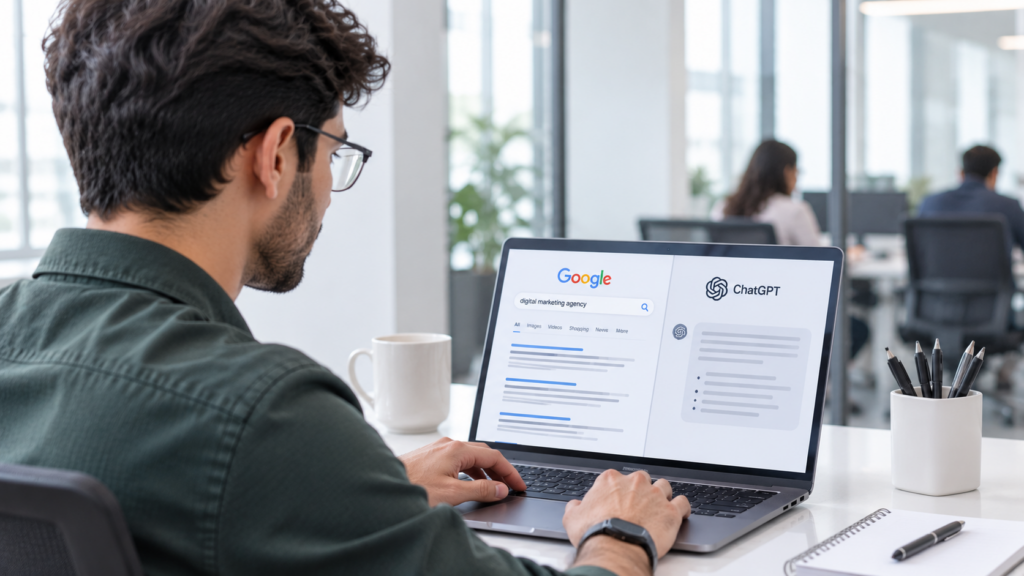
The way people search for information online is changing. Instead of typing a few keywords into Google and browsing through multiple links, users are increasingly asking detailed questions on AI-powered platforms such as ChatGPT, Google AI Overviews, Gemini and Perplexity. These tools generate direct answers, summarise information and may cite websites or recommend brands as part of their responses.
This shift has introduced a new approach to digital visibility: Generative Engine Optimization (GEO).
Traditional Search Engine Optimization (SEO) focuses on improving a website’s visibility in search engine results pages (SERPs). GEO, on the other hand, focuses on making a brand’s content clear, credible and useful enough to be referenced in AI-generated answers.
Does this mean SEO is becoming irrelevant? Not at all. SEO remains an important foundation for online discovery, while GEO extends your visibility into AI-driven search experiences. Businesses need to understand how both approaches work and how they can complement each other.
In this guide, we explain what GEO is, how it differs from SEO, and how businesses can build a search strategy that supports visibility across both traditional and generative search platforms.
What Is GEO (Generative Engine Optimization)?
Generative Engine Optimization (GEO) is the process of improving website content, brand information and online authority so that generative AI platforms can understand, reference and potentially include them in AI-generated responses.
These platforms use large language models (LLMs), sometimes combined with live web search, to interpret questions and produce conversational answers. Rather than simply displaying a list of links, they may summarise information from multiple sources and provide citations or recommendations.
For example, a user might ask an AI platform:
“Which digital marketing agency can help a D2C brand improve its online visibility in India?”
The platform may generate a response based on information it can access about agencies, their services, expertise, published content and online reputation. GEO aims to improve the likelihood that a brand’s relevant information is understood and considered in such responses.
GEO involves making content:
- Relevant: Directly address the questions and needs of your target audience.
- Clear: Use straightforward language, descriptive headings and well-organised sections.
- Credible: Support important claims with reliable information, evidence and expert insights.
- Contextual: Explain concepts in enough detail for AI systems and readers to understand them.
- Consistent: Maintain accurate brand information across your website and other credible online sources.
GEO does not guarantee that an AI platform will mention or recommend a particular business. Generative platforms use different systems and selection signals, and their responses can change. The objective is to build a strong, accessible and trustworthy digital presence that supports AI visibility.
What Is SEO (Search Engine Optimization)?
Search Engine Optimization (SEO) is the process of improving a website’s visibility in unpaid search engine results. It involves optimising website content, technical performance and authority to help search engines discover, understand and rank relevant pages.
When someone searches for a term such as SEO services or best digital marketing agency in Pune, search engines evaluate different factors to determine which pages are most relevant and useful.
A well-planned SEO strategy helps businesses attract people who are actively looking for information, products or services.
Key Elements of SEO
1. Keyword Research
Keyword research identifies the words and phrases people use when searching online. It helps businesses understand search intent and create content that addresses their audience’s needs.
For example, a digital marketing agency may target keywords such as:
- SEO services
- SEO digital marketing
- SEO marketing
- SEO strategy
- On-page SEO
The objective is to use relevant keywords naturally in website content, headings, URLs and metadata.
2. On-Page SEO
On-page SEO focuses on optimising individual website pages to improve their relevance and usability. It includes:
- Writing descriptive title tags and meta descriptions.
- Using clear H1, H2 and H3 headings.
- Organising content around relevant search queries.
- Adding descriptive image alt text.
- Using internal links to connect related pages.
- Improving readability and content structure.
3. Technical SEO
Technical SEO helps search engines crawl, render and index a website effectively. Important areas include website speed, mobile-friendliness, HTTPS, XML sitemaps, canonical tags, structured data and crawlability.
4. Off-Page SEO
Off-page SEO focuses on building a website’s reputation and authority beyond its own pages. Activities may include earning relevant backlinks, digital PR, brand mentions and publishing useful content on credible external platforms.
5. Content and User Experience
Useful, original content and a positive user experience are essential to a sustainable SEO strategy. Pages should satisfy the search intent, provide clear information and make it easy for visitors to take the next step.
Together, these activities help websites become more discoverable in traditional search results.
GEO vs SEO: What Is the Difference?
GEO and SEO share the broader goal of improving online visibility, but they focus on different search experiences.
SEO primarily aims to help web pages appear prominently in traditional search results. GEO aims to make a brand’s information more likely to be understood, referenced or cited in AI-generated responses.
For example, SEO may help a blog rank for what is performance marketing, while GEO focuses on making the blog’s explanation clear and useful enough to be referenced when an AI platform answers a related question.
GEO vs SEO: Key Differences at a Glance
| Comparison | SEO | GEO |
| Full form | Search Engine Optimization | Generative Engine Optimization |
| Primary objective | Improve rankings in search results | Improve visibility in AI-generated responses |
| Main platforms | Google, Bing and other search engines | ChatGPT, Gemini, Perplexity and AI-powered search experiences |
| Content approach | Keyword relevance, search intent and comprehensive content | Clear answers, context, credible information and extractable insights |
| Results format | A list of links and search features | Synthesised answers, recommendations and source citations |
| Visibility indicators | Rankings, impressions and organic clicks | AI mentions, citations, recommendations and referral visits |
| Authority signals | Relevant backlinks, content quality and website reputation | Credibility, consistent information and recognition across relevant sources |
| User journey | Users often visit multiple pages to compare information | Users may receive a summary before deciding whether to visit a source |
| Measurement | Search Console, analytics and rank tracking | AI visibility monitoring, citation tracking and referral analysis |
The distinction is not absolute. Search engines and generative platforms use different systems, and their capabilities overlap. SEO fundamentals such as useful content, accessible pages and clear site structure can also support GEO.
1. Search Rankings vs AI Citations
One of the biggest differences between SEO and GEO is how visibility is achieved.
In traditional SEO, businesses aim to rank their web pages for relevant keywords. A user searching for SEO services may see several agencies listed on the search engine results page and choose which website to visit.
In GEO, the focus is on whether an AI platform includes a brand, its content or its information in a generated answer. A user asking for recommendations may receive a synthesised response that references only selected sources.
A high Google ranking does not automatically guarantee an AI citation. Similarly, appearing in an AI-generated answer does not necessarily mean the source ranks first in traditional search results.
2. Keyword Optimisation vs Question-Based Content
SEO uses keyword research to understand what people search for and how to create relevant pages around those queries.
GEO places additional emphasis on natural-language questions and the context behind them. Instead of focusing only on a phrase such as SEO strategy, content should also address questions like:
- What is an SEO strategy?
- How do businesses create an SEO strategy?
- Which SEO activities improve organic visibility?
- How can SEO and GEO work together?
This approach helps content address the complete information need rather than simply repeating a target keyword.
However, keyword research remains useful for GEO. Search queries reveal audience interests, common questions and topics that deserve coverage.
3. Search Engine Crawling vs Generative AI Understanding
Traditional search engines discover pages through crawling and indexing. They then use ranking systems to determine which pages are relevant to a query.
Generative AI platforms work differently. Depending on the platform and whether it uses live search, they may draw on model knowledge, retrieved web pages, connected sources or a combination of these to formulate an answer.
This means content needs to be accessible and understandable, but it should also communicate its meaning clearly. Descriptive headings, concise explanations, relevant context and verifiable claims can make information easier to interpret and reuse.
4. Backlinks and Authority vs Broader Brand Credibility
Backlinks remain an important part of many SEO strategies because relevant links can help search engines understand a website’s authority and relevance.
GEO also benefits from a credible digital presence, but it should not be reduced to building backlinks or collecting brand mentions. Businesses should focus on demonstrating genuine expertise through useful content, accurate information, relevant references, original insights and consistent brand details.
For example, a marketing agency can strengthen its credibility by publishing detailed service pages, sharing case studies, explaining its processes and maintaining consistent business information across trusted platforms.
5. Organic Traffic vs AI Visibility
SEO performance is commonly measured through organic impressions, clicks, keyword rankings, landing-page traffic and conversions.
GEO requires additional ways to evaluate visibility. Businesses can monitor:
- How frequently their brand appears in relevant AI responses.
- Whether AI platforms cite their website.
- Which pages or topics are being referenced.
- Whether competitors appear more often for relevant prompts.
- How much referral traffic arrives from AI platforms.
- Whether AI-assisted discovery contributes to enquiries or conversions.
GEO measurement is still evolving, and results can vary across prompts, platforms and time. It is therefore useful to combine visibility indicators with business outcomes rather than relying on a single metric.
How Do GEO and SEO Work Together?
GEO should not replace SEO. Both approaches can work as part of a connected digital marketing strategy.
SEO helps establish a strong website foundation through relevant content, technical accessibility, keyword targeting and authority building. GEO extends this work by making information easier to interpret, extract and reference in generative search experiences.
Consider a business publishing a guide on SEO digital marketing.
Its SEO strategy may include:
- Researching relevant keywords and search intent.
- Creating a comprehensive guide.
- Optimising title tags, headings and internal links.
- Improving page speed and mobile usability.
- Earning relevant backlinks.
Its GEO strategy may build on the same guide by:
- Answering common questions directly.
- Defining SEO concepts clearly.
- Including practical examples and original insights.
- Citing reliable sources for factual claims.
- Using descriptive headings and structured sections.
- Keeping brand and service information accurate and consistent.
The result is content designed to serve people across both traditional and AI-powered discovery journeys.
7 Ways to Optimise Your Website for GEO
A successful GEO strategy begins with content that genuinely helps users. The following practices can help businesses improve the clarity, usefulness and credibility of their online information.
1. Create Helpful, Answer-Focused Content
Start by understanding the questions your audience asks before making a purchase or choosing a service.
Build content around those questions and provide direct answers near the beginning of relevant sections. Follow each answer with supporting explanations, examples and practical details.
For example, a page targeting SEO services should clearly explain what the services include, who they are suitable for, how the process works and what outcomes businesses can reasonably expect.
Avoid vague introductions that delay the answer. Make the most useful information easy to find.
2. Use Clear Headings and Content Structure
Well-organised content benefits readers and makes individual sections easier to understand.
Use:
- One descriptive H1 for the main topic.
- H2 headings for major sections.
- H3 headings for supporting topics.
- Short paragraphs for readability.
- Numbered steps for processes.
- Tables for comparisons.
- FAQs for common questions.
Each section should focus on a specific subject and provide enough context to stand on its own.
3. Demonstrate Experience and Expertise
Trust is important when users rely on AI-generated answers to research products, services or businesses.
Strengthen content credibility by including:
- Author names and relevant professional experience.
- Original research, data and practical examples.
- Case studies with clearly explained results.
- References to reliable sources.
- Updated information where facts or recommendations change.
- Clear business and contact information.
Avoid unsupported statistics, exaggerated claims and generic content that offers little value beyond what is already available online.
4. Strengthen Your Brand’s Online Presence
Your website is not the only place where people discover information about your business. Your brand may also be represented through industry publications, business directories, professional profiles, customer reviews and other relevant platforms.
Maintain consistent business details, service descriptions and brand messaging across these sources.
Focus on earning genuine mentions and recognition through useful contributions, digital PR, partnerships and industry-relevant content. Do not treat every mention or backlink as equally valuable.
5. Use Structured Data Where Relevant
Structured data helps search engines understand specific information on a web page. Depending on the content, relevant schema types may include:
- Article
- BreadcrumbList
- Organization
- LocalBusiness
- Product
- Service
Use schema that accurately reflects visible page content and follows the relevant search engine guidelines.
Structured data is not a guaranteed way to earn AI citations or rankings. Its primary purpose is to provide explicit context about the information on a page.
6. Publish Comprehensive and Original Content
Build topical depth by covering the questions and subtopics related to your core services or industry.
For example, a business offering SEO services could publish content about:
- Keyword research and search intent.
- On-page SEO and technical SEO.
- Content marketing and link building.
- Local SEO.
- SEO audits and reporting.
- SEO strategy for different industries.
Connect related articles through relevant internal links. Add original insights, practical examples and useful explanations instead of publishing multiple pages that repeat the same information.
7. Monitor AI Visibility and Update Content
GEO is not a one-time optimisation activity. AI platforms and search experiences continue to evolve, so businesses should regularly review their content and visibility.
Test relevant questions across different AI platforms and observe:
- Whether your brand is mentioned.
- Whether your website is cited.
- Which competitors are recommended.
- Whether the information about your business is accurate.
- Which topics or questions your content does not adequately address.
Use these observations to improve content quality, fill information gaps and strengthen your overall search strategy.
These practices align with the broader recommendations to combine technical readiness with clear, context-rich content and credible information.
Informa TechTarget+2
How to Measure GEO and SEO Performance
Since SEO and GEO aim to improve visibility in different search experiences, their performance should be monitored using a combination of metrics.
| SEO Metrics | GEO Metrics |
| Organic clicks | AI referral visits |
| Search impressions | AI-generated brand mentions |
| Keyword rankings | AI citations and source references |
| Organic conversions | Conversions from AI-referred sessions |
| Backlink profile | Brand visibility across relevant AI responses |
| Indexed pages | Accuracy and consistency of brand information in AI answers |
Tools for Measuring SEO
Businesses can use tools such as:
- Google Search Console: Monitor search impressions, clicks, queries and indexing.
- Google Analytics 4: Analyse website traffic, user behaviour and conversions.
- SEO platforms: Track keyword rankings, backlinks, technical issues and competitor performance.
Ways to Monitor GEO
GEO measurement is less standardised than traditional SEO reporting. Businesses can begin with a repeatable manual process:
- Identify relevant questions customers may ask AI platforms.
- Test those questions across platforms such as ChatGPT, Gemini and Perplexity.
- Record whether your brand or website is mentioned or cited.
- Compare the results with relevant competitors.
- Repeat the tests periodically using consistent prompts.
- Review analytics for referral traffic and conversions from AI platforms.
A consistent tracking process helps businesses identify changes over time without assuming that one AI response represents overall visibility.
Is GEO Replacing SEO?
No. GEO is expanding how businesses approach search visibility, but it does not make traditional SEO unnecessary.
People still use search engines to compare services, research products, find local businesses and visit websites. At the same time, AI-powered tools are creating additional ways to discover and evaluate information.
A website with poor technical health, unclear content or inaccurate information may struggle to perform well across both traditional and generative search experiences.
The more practical approach is to build on existing SEO foundations and incorporate GEO principles into the same content and digital marketing strategy.
Businesses should continue investing in keyword research, on-page SEO, technical optimisation, relevant backlinks and useful content while making their information more accessible, credible and answer-focused.
Final Thoughts
The shift towards AI-powered discovery is changing how brands need to approach online visibility. SEO helps businesses improve their presence in traditional search results, while Generative Engine Optimization focuses on making their information more useful and recognisable within AI-generated responses.
The two approaches are not competing strategies. They are complementary parts of a broader search visibility plan.
For businesses, the priority should be to create content that answers real questions, demonstrates expertise, maintains accurate information and provides a valuable user experience. By combining a strong SEO strategy with GEO-focused improvements, brands can prepare for a search landscape where people discover information through both search engines and AI platforms.
Looking to strengthen your brand’s visibility across traditional and AI-powered search? Explore how RB2F can support your business with SEO, AEO and GEO-focused digital marketing strategies.
Frequently Asked Questions (FAQs)
1. What is GEO in digital marketing?
GEO stands for Generative Engine Optimization. It is the process of improving a brand’s content and online presence so AI-powered platforms can understand, reference or cite its information in generated responses.
2. What is the main difference between GEO and SEO?
SEO focuses on improving website rankings in traditional search engine results, while GEO focuses on increasing a brand’s visibility in AI-generated answers. Both aim to improve online discoverability but target different search experiences.
3. Is GEO replacing traditional SEO?
No. Traditional SEO remains important for organic search visibility, website traffic and discoverability. GEO builds on SEO by helping businesses make their content more accessible, credible and useful for generative AI platforms.
4. How can businesses optimise their websites for GEO?
Businesses can improve GEO by publishing helpful, answer-focused content, using clear headings, demonstrating expertise, maintaining accurate brand information and earning credible online mentions. They should also monitor how their brands appear in AI-generated responses.
5. Which tools can help measure GEO performance?
Businesses can use AI visibility monitoring platforms and manually test relevant questions across ChatGPT, Gemini and Perplexity. Google Analytics 4 can help monitor AI referral traffic, while Google Search Console remains useful for tracking traditional organic search performance.

I help brands navigate the evolving search landscape through technical SEO, content strategy, AI-driven search, and Generative Engine Optimization (GEO). Passionate about making brands discoverable across traditional search engines and AI platforms, I bring 8 years of experience in driving sustainable, data-driven organic growth.